Most Regina homeowners don't think about their foundation until water appears on the basement floor or a door suddenly won't close. The trouble is, by that point the problem has usually been developing underground for months "” or years "” driven by one of the most problematic soils in western Canada and a climate that punishes foundations year-round.
Regina's heavy clay soil expands when wet and shrinks when dry, exerting forces on your foundation that can crack reinforced concrete. Saskatchewan's deep frost line means every spring brings potential heave. And rapid snowmelt on flat prairie terrain sends large volumes of water straight toward your foundation walls within days of a thaw. These aren't occasional risks "” they are built into the Regina calendar.
The good news: foundation cracks communicate clearly if you know how to read them. This guide explains why Regina's specific conditions are so hard on foundations, what each crack type means, and which warning signs mean you need to act now rather than monitor and wait.
Why Regina's Soil Is Your Foundation's Biggest Enemy
Regina sits on one of the most expansive clay deposits in western Canada. This material "” known to geologists as Regina Clay, a fine marine sediment left by prehistoric Lake Regina "” is composed of particles that absorb moisture aggressively and react dramatically to changes in water content. Understanding this soil is the foundation of understanding your foundation.
Regina's conditions compound this problem in ways that set it apart from most Canadian cities:
- Deep frost line. Regina's frost line reaches approximately 2.1 metres "” among the deepest in the Prairies. Foundations that don't extend below this line, or that have poor drainage, are vulnerable to frost heave every spring as saturated soil freezes and expands beneath the footing.
- Rapid spring snowmelt. The flat prairie landscape offers no topographic relief. Large volumes of meltwater have nowhere to drain quickly "” it saturates the clay around foundation walls within days, generating the maximum hydrostatic pressure precisely when freeze-thaw stress is also peaking.
- Prairie drought cycles. Multi-year dry stretches cause severe soil shrinkage, pulling the ground away from foundation walls and creating voids under footings that cause uneven settlement.
- Older home stock at highest risk. Homes built before 1980 in Cathedral Village, Lakeview, Normanview, Whitmore Park, and Glencairn may have shallower footings, no modern drainage systems, and masonry block foundations with mortar joints that have aged for 50+ years in this demanding soil.
"The biggest problem in Saskatchewan is lack of moisture "” but the damage comes from the swing between extremes. Drought shrinks the clay away from your foundation. Then spring snowmelt saturates it overnight. Concrete isn't built for that kind of movement year after year."
"” RSR Construction, Regina SKThe 4 Types of Foundation Cracks "” and What Each One Means
Not all foundation cracks are equal. The shape, direction, width, and location of a crack each tell you something specific about the forces causing it. Learning to read these signs helps you distinguish between a cosmetic issue worth monitoring and a structural problem that needs a professional on site this week.
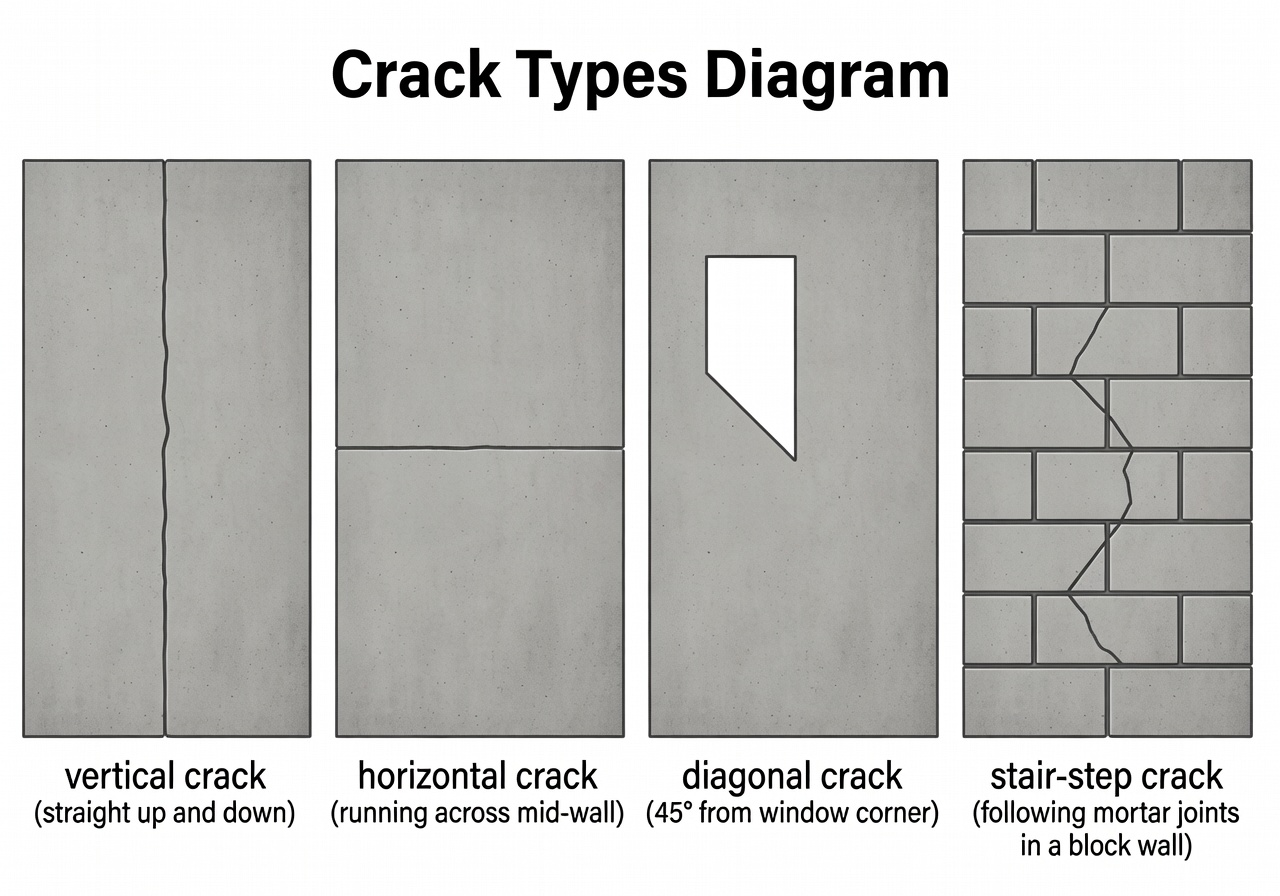
Vertical cracks run straight up and down the foundation wall and are the most common type in Regina homes. They often result from concrete curing shrinkage "” normal in the first one to two years after construction "” or from gradual settling over decades. In most cases, a narrow vertical crack with no moisture present is a monitoring situation rather than an emergency.
In Regina's climate, however, even a dry vertical crack deserves attention. An opening that is fine in September can become an active leak by April as rapid snowmelt generates hydrostatic pressure behind the wall "” forcing water through any available gap.
A vertical crack wider than 6mm (a quarter coin), one that widens at the top or bottom rather than running uniformly, or any vertical crack that weeps water during snowmelt or heavy rain should be assessed professionally. Epoxy injection is used for dry structural cracks; polyurethane foam injection for actively leaking ones "” using the wrong product is a costly and common mistake.
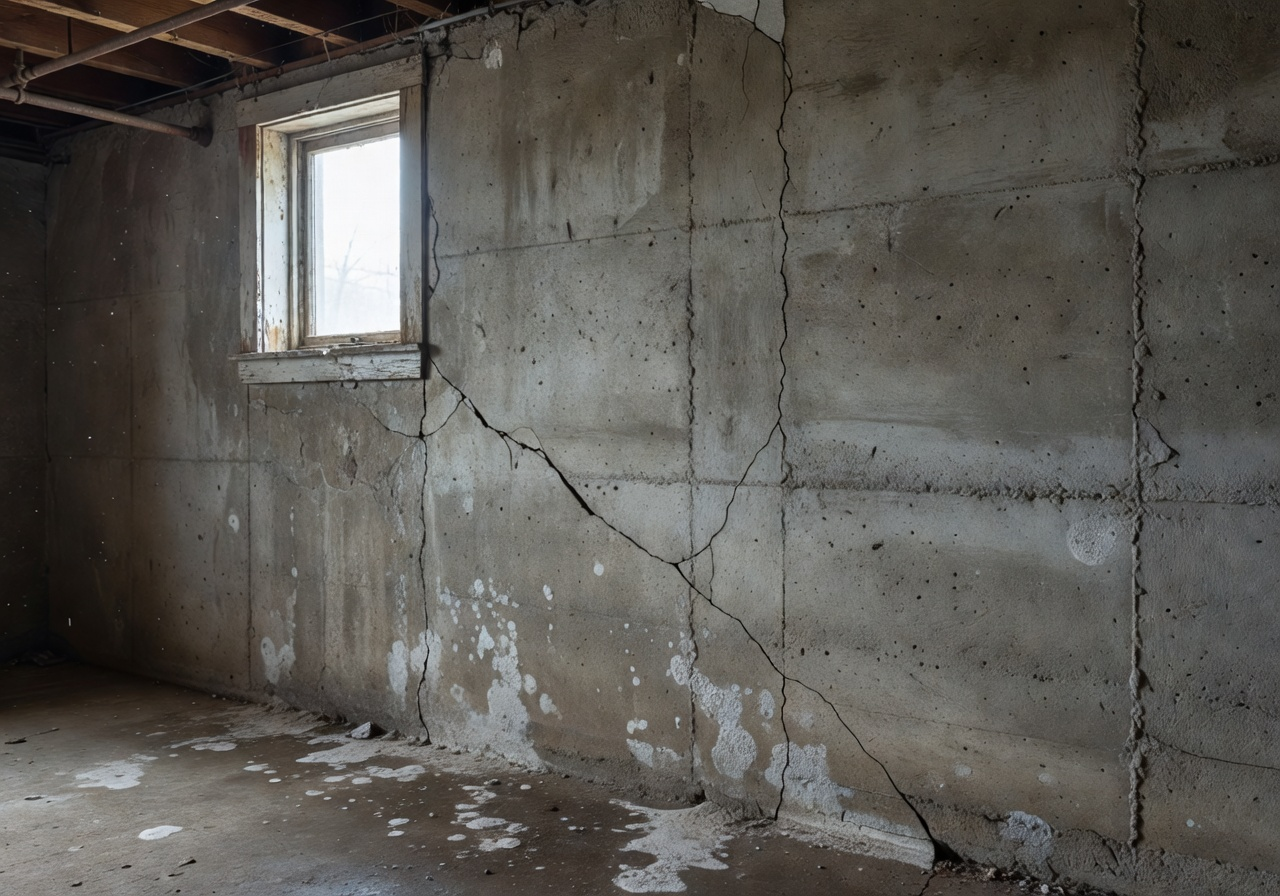
Horizontal cracks run across the foundation wall, typically at mid-height, and are the most serious crack type. They indicate that lateral soil or water pressure is pushing inward against the wall "” the very pressure you would expect from saturated Regina clay after spring snowmelt, or from expansive soil swelling during a wet fall. A wall with a horizontal crack is at risk of inward bowing and eventual structural collapse if the lateral pressure source is not addressed.
Epoxy injection alone is never sufficient for a horizontal crack "” it treats the symptom while ignoring the cause. Proper repair requires addressing the lateral pressure, typically with carbon fibre strap reinforcement bonded to the wall face, steel beam bracing from floor to ceiling, or in severe cases, full wall replacement.
A horizontal crack that shows any visible inward bowing of the wall is a structural emergency. Stop using the basement for storage in the affected area, do not attempt DIY repair, and book a professional assessment immediately. The longer lateral pressure acts on a bowing wall, the more expensive and invasive the repair becomes.
Diagonal cracks run at an angle "” typically 45° or steeper "” and almost always originate from the corner of a window or door opening. They are caused by differential settlement: one section of the foundation sinking or lifting more than another. In Regina, this is closely linked to uneven clay drying "” a sun-exposed corner dries and contracts while a shaded north corner retains moisture, causing the two sides to move at different rates.
The wider end of a diagonal crack points toward the origin of the movement. A crack that is wider at the bottom indicates the foundation is settling downward on that side. Wider at the top suggests the foundation is heaving or lifting.
Mark each end of the crack with a pencil and date it. Recheck in 4"“6 weeks. If the crack has extended past your marks, settlement is active "” which changes both the urgency and the repair approach. Active settlement may require helical or push pier underpinning rather than crack injection alone.
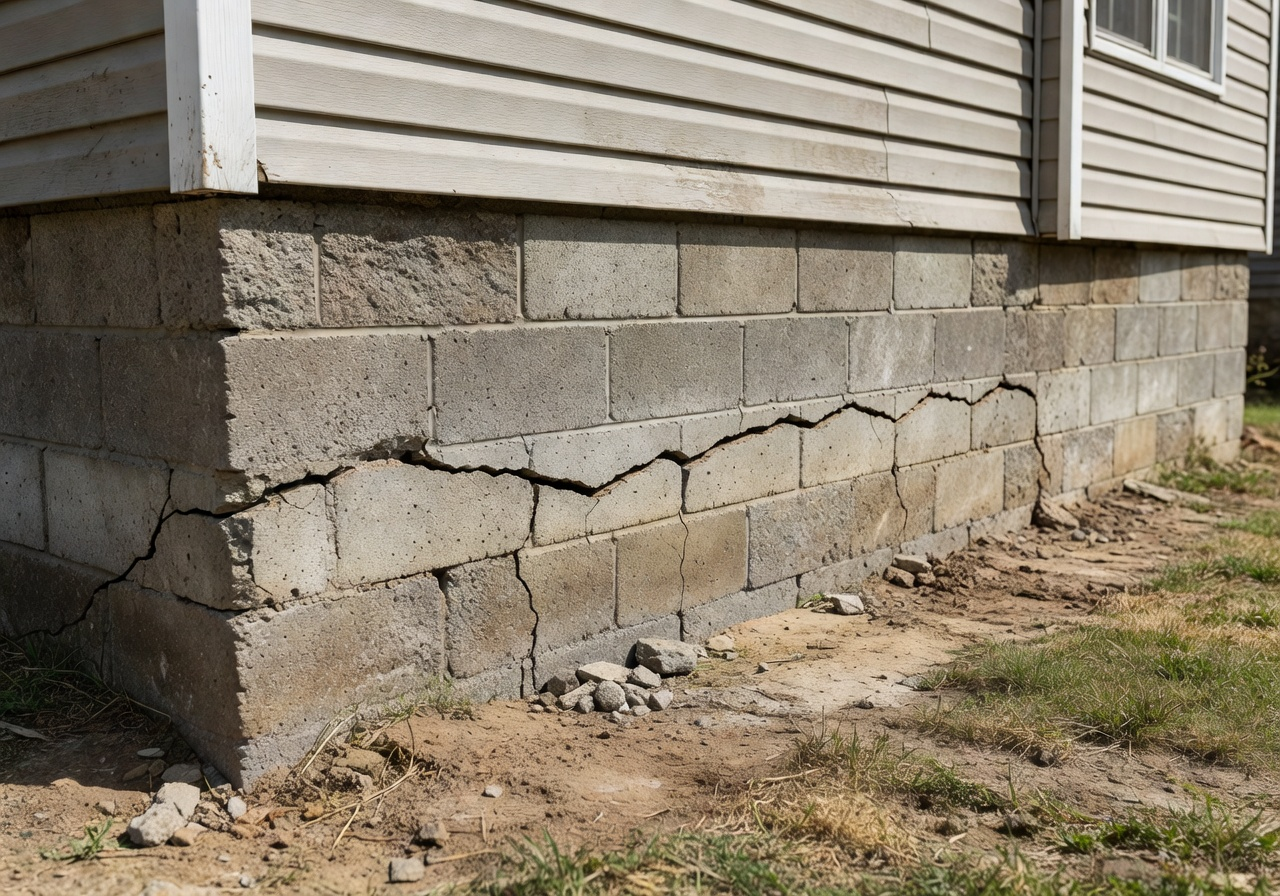
Stair-step cracks follow mortar joints in a staircase pattern and are found almost exclusively in concrete block or brick masonry foundations "” the type common in Regina homes built before 1980 in older neighbourhoods like Cathedral Village, Lakeview, and Normanview West. The crack travels through the mortar rather than the blocks themselves, because mortar joints are the weakest point in any block wall.
Stair-step cracking is caused by the same differential settlement and shrink-swell forces that produce diagonal cracks in poured concrete "” but in a masonry foundation, the movement expresses itself through the joint lines. Severity depends on width and displacement: hairline stair-step cracks in mortar joints may need only professional tuckpointing and repointing; wide cracks with visible blocks displaced inward or outward are a structural concern requiring engineering assessment.
Stair-step crack repair in block or brick foundations is a masonry trade job "” not a general contractor scope. Matching mortar hardness and composition to the original block is critical; overly hard Portland cement mortar in an older soft-mortar block wall transfers future stress through the blocks themselves rather than the joints, causing spalling and face damage.
Regina-Specific Warning Signs Beyond the Crack Itself
Foundation distress doesn't always announce itself with a visible crack. These secondary signals "” often appearing in your living space rather than the basement "” indicate that foundation movement is affecting the structure of your home. Any combination of these signs warrants a professional inspection.
Repair Options "” From DIY Monitoring to Professional Intervention
Foundation crack repair exists on a spectrum "” from a homeowner with a tube of hydraulic cement sealing a hairline shrinkage crack, to a structural engineering firm underpinning a sinking foundation with helical piers. Understanding where your situation falls on that spectrum determines both the urgency and the budget required.
| Crack Type & Condition | Severity | Typical Repair Method | Estimated Cost (CAD) |
|---|---|---|---|
| Hairline vertical, dry, no movement | Low | Monitor; seal with hydraulic cement or crack filler | $0"“$200 DIY |
| Vertical crack, actively leaking in spring | Moderate | Polyurethane foam injection (professional) | $400"“$900 per crack |
| Vertical or diagonal "” structural concern, dry | Moderate"“High | Epoxy injection + carbon fibre strap reinforcement | $800"“$2,500 |
| Stair-step cracks in block or brick foundation | Moderate | Tuckpointing / masonry repointing; carbon fibre if bowing | $500"“$2,000+ |
| Horizontal crack, mid-wall | High | Carbon fibre straps or steel beam bracing | $3,000"“$10,000 |
| Active settlement / sinking foundation section | High | Helical or push pier underpinning | $10,000"“$40,000+ |
A few critical distinctions worth understanding before any repair:
Epoxy vs. Polyurethane Injection
Epoxy injection bonds cracked concrete back to near-original structural strength "” the correct choice for a dry crack where structural continuity matters. Polyurethane foam expands on contact with moisture, sealing an actively leaking crack with a flexible, waterproof plug that accommodates minor future movement. Using epoxy on a crack that actively weeps water in spring is a common and costly mistake "” the epoxy won't bond properly to wet concrete and the repair fails within a season.
Carbon Fibre Straps for Bowing Walls
Carbon fibre reinforcement straps are bonded vertically to the interior face of a bowing foundation wall and anchored at the floor slab and rim joist. They provide significant tensile resistance to further inward movement without requiring excavation "” making them a significantly less expensive and less disruptive option than exterior waterproofing for moderate horizontal cracking. They do not, however, push an already-bowed wall back "” they arrest further movement. If a wall is bowing more than 2 inches from plumb, excavation may be required.
Tuckpointing for Stair-Step Cracks
Stair-step crack repair in a masonry block or brick foundation is specifically a masonry trade scope of work. Matching mortar hardness to the original block material is not a detail "” it is the difference between a repair that lasts 20 years and one that fails in two. A hard modern Portland cement mortar applied to an older soft-mortar block wall transfers all future stress through the block faces rather than the joints, causing spalling and face damage that is far more expensive to correct.
The Right Time to Repair "” Regina's Seasonal Window
Timing foundation repairs to Regina's seasons affects both the quality of the work and the cost. Masonry and concrete repair has specific temperature requirements "” scheduling repairs in the right window is not just convenient, it is technically necessary.
DIY Monitoring vs. When to Call a Professional
Foundation cracks create homeowner paralysis "” either dismissing something serious as cosmetic, or panicking over a normal shrinkage crack. This framework helps you categorize clearly.
- Photograph all cracks with a ruler for scale; date each photo
- Mark crack ends with pencil and date "” recheck in 4"“6 weeks for growth
- Measure crack width with a feeler gauge (a credit card = ~0.76mm; a quarter coin = ~6mm)
- Check indoors for correlated signs: door sticking, floor slope, drywall cracks at room corners
- Seal hairline, dry, non-structural vertical cracks with hydraulic cement or a quality crack sealant
- Fill soil gaps against foundation with compacted clay-based fill and regrade
- Extend downspouts and improve grading away from the foundation
- Any horizontal crack "” regardless of width or length
- Any crack with visible inward or outward displacement between the two sides
- A crack wider than 6mm (a quarter coin)
- Active water entry through any crack during rain or snowmelt
- Doors or windows suddenly misaligning in multiple rooms simultaneously
- Cracks appearing in multiple locations throughout the foundation at once
- Stair-step cracks showing block displacement or that are actively widening
- Any crack that has grown past pencil marks within 4"“6 weeks
- Before purchasing an older Regina home with visible foundation issues
When in doubt about severity, a professional inspection costs a fraction of the risk of misdiagnosing a structural crack as cosmetic. Most reputable Regina masonry contractors provide free or low-cost assessments "” the visit pays for itself in peace of mind if nothing serious is found, and in early intervention savings if something is.
5 Prevention Tips Every Regina Homeowner Should Know
Frequently Asked Questions
Concerned About a Crack in Your Foundation?
Our team provides free foundation assessments for Regina homeowners "” we'll identify crack type, explain severity honestly, and recommend only what's actually needed. No pressure, no upselling.
Book Your Free Inspection → Tuckpointing & Repointing Services